Why passport photos get rejected, and how to catch it first
Most rejections come down to shadows, the crop, or a file that misses the upload spec. Here is what each authority actually checks, and what you can verify yourself before submitting.
A rejected passport photo is rarely rejected for the reason people assume. It is almost never "you look bad in it". It is usually one of two things: a measurable geometry problem, or a file that does not meet the upload spec. Both are checkable before you submit, and both are cheaper to fix now than after the application has been returned.
The reasons that come from the photograph itself
Shadows. This is the single most common cause. A shadow cast on the wall behind you breaks the "plain, uniform background" rule; a shadow across one side of your face breaks the "evenly lit" rule. Both come from the same mistake, which is standing close to a wall with one light source. Stand about a metre away from the wall and face a window, and most shadow problems disappear.
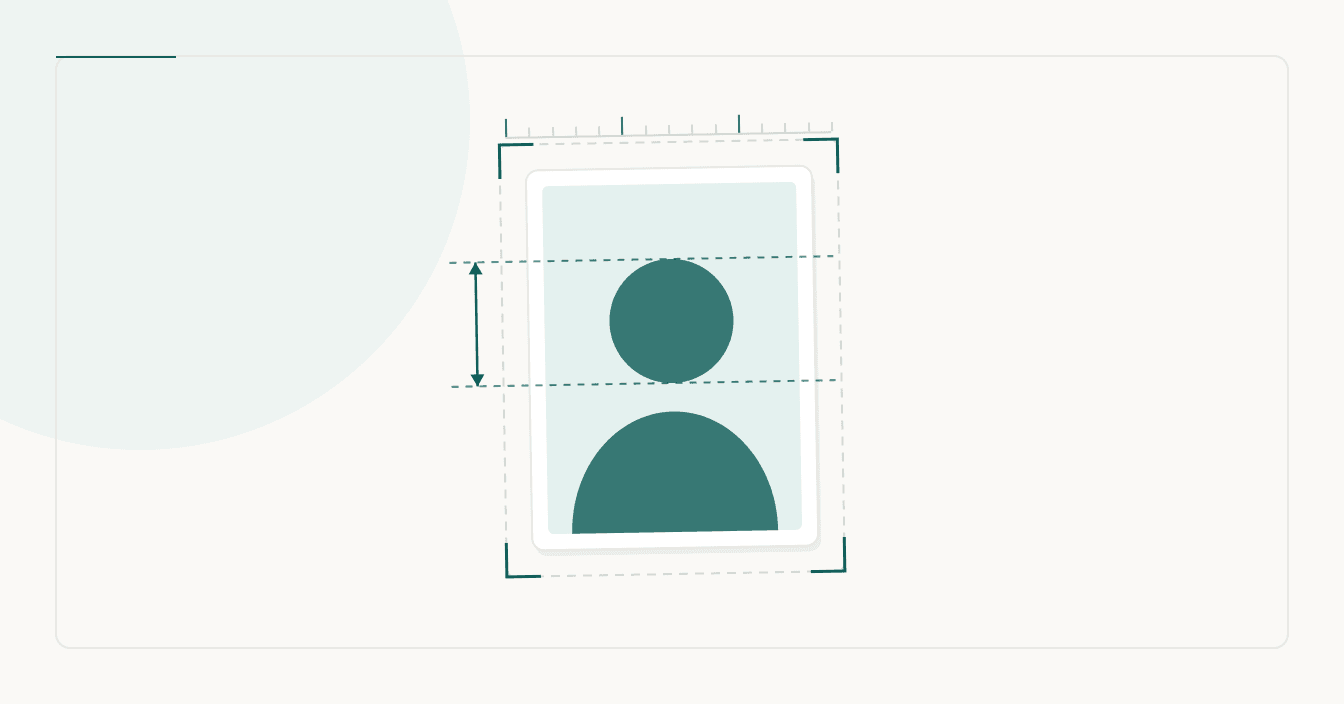
The crop. Authorities do not just want a certain photo size, they want your head to occupy a certain proportion of it. The UK and most of the Schengen area work to a 35 × 45 mm photo with 29–36 mm from chin to the top of the head, hair included. The United States wants a square 2 × 2 inch photo with 1 to 1⅓ inches of head. Canada asks for 50 × 70 mm with 31–36 mm of face. A photo cropped by eye tends to be too tight at the top or too far away, and "head too small in frame" is a standard rejection line.
The photo is not recent. Six months is the usual limit. There is no way for an examiner to date a photo precisely, but a visible change in appearance from a previous document is enough to trigger a query.
Glasses, hats and hair. The United States has not accepted glasses in passport photos since 2016. Most other authorities allow them only with no glare and no frame crossing the eyes, which in practice means most people are better off taking them off. Hair falling across an eye or an eyebrow is a rejection in its own right.
Expression. The UK requires a closed mouth and no smile. The US permits a neutral expression or a natural smile with both eyes open. Germany asks for a neutral expression with the mouth closed. These genuinely differ by country, so a photo that passed for one document can fail for another.
The rejections that are pure file mechanics
These have nothing to do with how you look, and they are the ones people find most frustrating because the upload form usually just says "invalid".
- Pixel dimensions. The US online systems want 600 × 600 to 1200 × 1200 px. The UK digital service wants at least 600 × 750 px. A photo cropped down from a screenshot often falls under these floors.
- File weight. US visa uploads cap at 240 KB. The UK accepts 50 KB to 10 MB. India's portals cap at 1 MB, China's at 120 KB. A phone photo straight out of the camera is several megabytes and will be refused before anyone looks at it.
- Format. JPEG, essentially everywhere. A recent iPhone shoots HEIC by default, and no government portal accepts HEIC. Converting it is a one-step job, but the error message rarely says so.
- Colour depth. Some systems require 24-bit colour and reject a greyscale file, even one that looks colour.
What "digitally altered" now means
Since the start of 2026 the major issuing authorities have been running automated checks for editing, and Canada bans altered photos outright. This covers beauty filters, skin smoothing, AI background replacement and anything that reconstructs part of the image. It does not cover a plain geometric crop, a resize, or a change of file format — those alter the framing and the file, not your face.
This is why FileFits does not offer background replacement or retouching, and will not. A tool that swaps your background for a clean white one is producing exactly the artefact these checks are designed to find.
Checking before you submit
The parts a machine can genuinely judge are the measurable ones. Our passport photo checker runs in your browser — the photo is never uploaded anywhere — and reports on dimensions, aspect ratio, file weight against a minimum and maximum, whether the image is actually in colour, how even the background is, sharpness, and an estimate of head size in the frame.
It is deliberately explicit about what it does not judge: expression, glasses, whether your eyes are open, and lighting on your face. And where the background is too busy to measure a silhouette against, it reports "could not be judged" rather than inventing a number. No tool, including this one, can tell you a photo will be accepted — that decision belongs to the person reviewing your application.
If the geometry is what needs fixing, the presets do the crop for you: 35 × 45 mm for the UK, Schengen and most of Europe, 2 × 2 inches for the United States, and 50 × 70 mm for Canada.
If it has already been rejected
Read the rejection notice literally. Most authorities name the failed rule, and the named rule is the one to fix — resubmitting a subtly different photo that fails the same test is the usual reason a photo gets rejected twice. If the notice mentions the background or lighting, retake the photo; if it mentions size, crop or file type, the original photo is probably fine and only the file needs work.