Passport Photo Hair Rules: Up, Down, Fringe and Ears
You can wear your hair down for a US or UK passport photo, and neither country needs your ears visible. The real issue is that hair changes your chin-to-crown measurement.
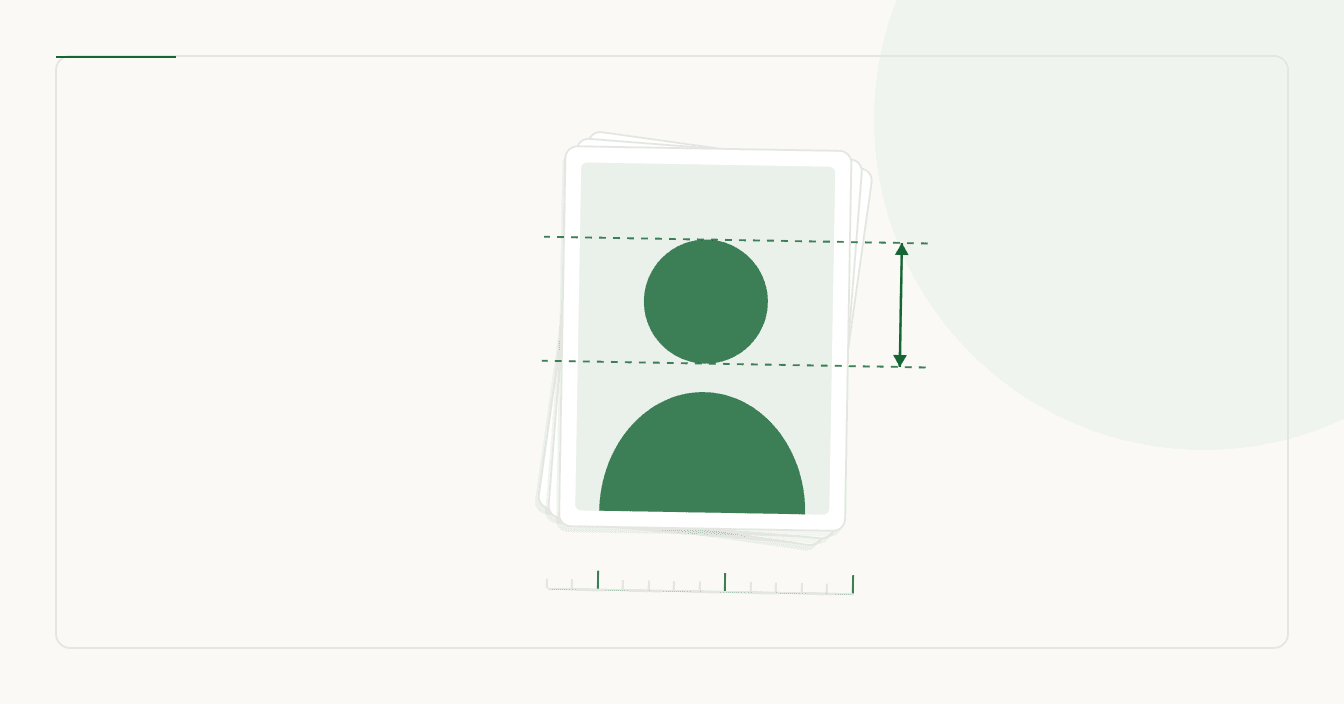
The short version: in both the United States and the United Kingdom you can wear your hair down. Neither government asks you to tie it back, and neither requires your ears to be visible. What they care about is that your face is unobstructed and that your head is the right size in the frame.
The second half of that sentence is the one nobody mentions, and it is where hair actually causes trouble.
The US rule: your hair can run off the edge of the photo
The State Department's guidance is unusually relaxed about this. Its position is that your hair may extend past the edges of the photo, as long as your entire head is shown and is the appropriate size.
So wide hair — curls, an afro, long hair falling outside the crop — is not a problem in itself. Volume that spills out of the frame sideways is explicitly tolerated. What is not tolerated is anything that stops the photo doing its job: your head must face the camera directly with your full face in view, with a neutral expression or a natural smile and both eyes open.
Two other US rules are worth having in the same place, because they catch people out far more often than hair does. The photo must have been taken in the last 6 months, and you cannot wear glasses — if you cannot remove them for medical reasons, you need a signed note from your doctor with the application.
The UK rule: nothing in front of your eyes
HM Passport Office is more specific and slightly stricter. Its photo rules say you must not have hair in front of your eyes, must be facing forwards and looking straight at the camera, and must have a plain expression and your mouth closed.
Note what is not there: no instruction to tie your hair back, no requirement to show your ears. A fringe is fine as long as it sits above the eyes rather than across them.
The UK is also stricter on how recent the photo is — it must have been taken in the last month, against six months for the US — and it publishes hard digital limits: at least 600 pixels wide and 750 pixels tall, and between 50 KB and 10 MB.
The part nobody mentions: hair changes your head measurement
Every passport spec measures your head from the bottom of the chin to the top of the head, and the top of your head means the top of your hair, not the top of your skull. For a US 2 × 2 inch photo that measurement has to land between 1 and 1 3/8 inches (25 to 35 mm).
That is a 10 mm window, and a hairstyle can move you several millimetres inside it.
- A high bun, a topknot or a big blow-dry adds height above your crown. The crop has to include it, which pushes the whole head measurement up and can take you over the maximum — or, once the crop is widened to fit, leave your face looking too small.
- Hair worn down generally adds width, not height, and width is the dimension the US rule explicitly forgives.
- Very flat hair can occasionally leave you under the minimum, though this is rarer.
If you have a choice, the safest style is the one that adds the least height above the crown of your head. That is a genuinely different piece of advice from "put your hair up", which is what most guides say and which is the option more likely to cause a problem.
Fringes, bangs and hair behind the ears
A fringe is acceptable in both countries provided it does not cover your eyes or cast a shadow over them. The failure is not the fringe, it is the eyes being obscured — the UK writes this as hair in front of your eyes, and the US requires both eyes open and visible.
Ears are a common worry and mostly a myth for these two countries. Neither the US nor the UK published guidance asks for your ears to be shown. Some countries do go further: Spain's DNI rules, for instance, state plainly that the ears do not have to be visible, which tells you how often the question comes up. If you are applying to a country whose rules you have not read, check its own text rather than assuming.
Things that are actually about hair and will get you rejected
- Shadows cast by your hair across your face or the background. Backgrounds must be plain and evenly lit, and hair is the usual culprit for a shadow on a wall.
- Hair merging into the background. The rules ask for a plain white or off-white background, and dark hair against a white wall is fine — but light hair against a white wall can wash out the outline of your head, which is exactly what an examiner is measuring.
- Head coverings. A hat is not allowed. A religious or medical head covering is, but your full face must be visible and it cannot obscure your hairline or cast shadows on your face.
- Anything edited. Do not retouch, filter or replace the background. Digitally altered photos are refused, and we deliberately do not offer those tools.
What our tools can and cannot tell you
The 2 × 2 inch tool and the 35 × 45 mm tool draw the head guides for the size you are making, so you can see whether your chin-to-crown measurement lands inside the window before you submit anything. That is the check that hair affects.
The passport photo checker goes a step further on a photo you already have: dimensions, file weight, background evenness, sharpness and an estimate of head size. It runs in your browser and nothing is uploaded.
It is worth being straight about the limits. The checker estimates head height from your outline rather than measuring facial landmarks, and it labels that number an estimate. It does not judge your expression, whether your eyes are open, or whether a fringe is sitting too low. No online tool can promise a photo will be accepted — the decision belongs to the examiner. What these tools can do is stop you failing on the measurable things.